Palabras clave
Cosmología
Quintaesencia
K-esencia
Campos fantasma
Cómo citar
Share
Resumen
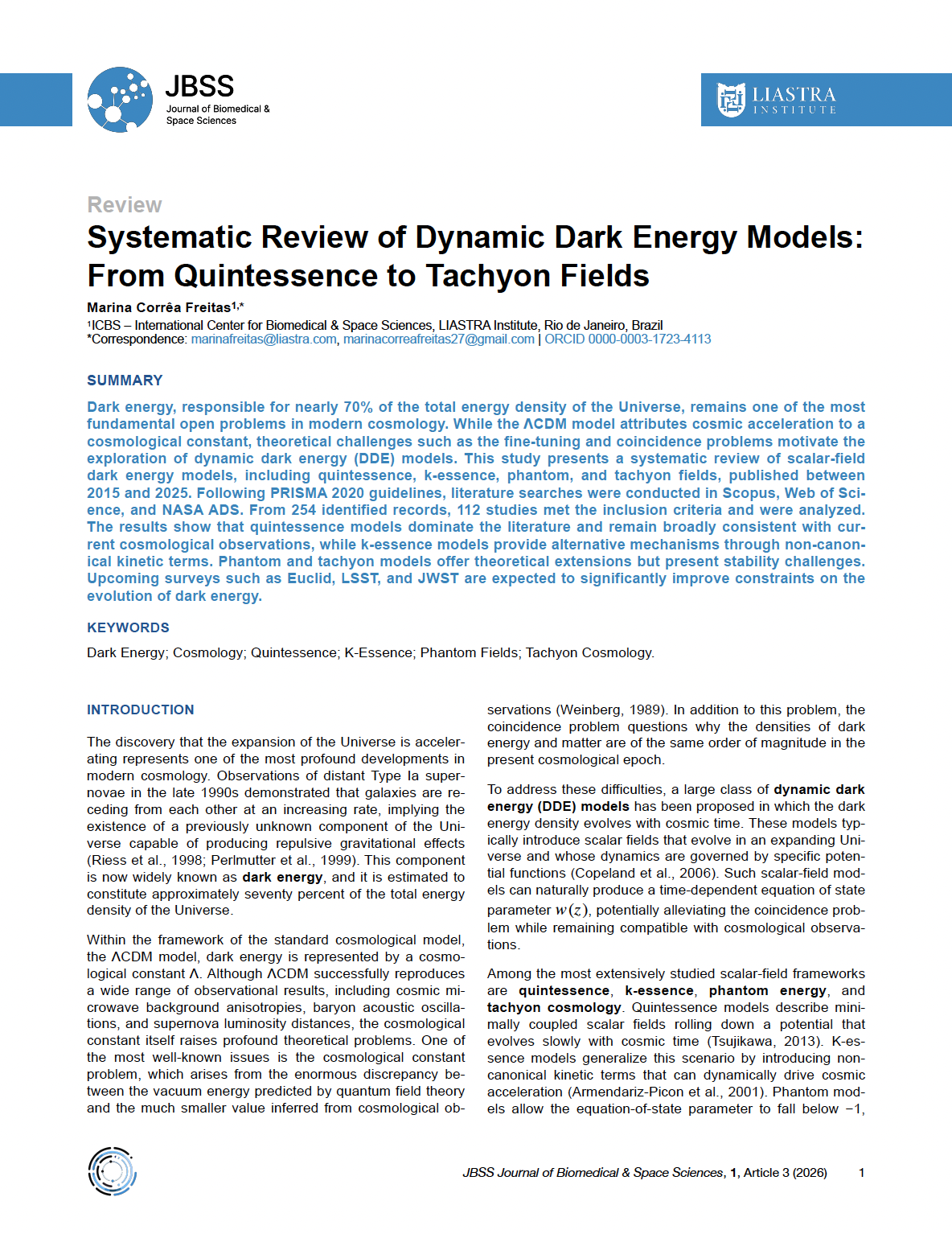
La energía oscura, responsable de casi el 70% de la densidad total de energía del Universo, sigue siendo uno de los problemas abiertos más fundamentales de la cosmología moderna. Aunque el modelo ΛCDM atribuye la aceleración cósmica a una constante cosmológica, desafíos teóricos como los problemas de ajuste fino y coincidencia motivan la exploración de modelos dinámicos de energía oscura (DDE). Este estudio presenta una revisión sistemática de modelos de energía oscura basados en campos escalares, incluidos la quintaesencia, la k-esencia, los campos fantasma y los campos de taquiones, publicados entre 2015 y 2025. Siguiendo las directrices PRISMA 2020, se realizaron búsquedas bibliográficas en Scopus, Web of Science y NASA ADS. De los 254 registros identificados, 112 estudios cumplieron con los criterios de inclusión y fueron analizados. Los resultados muestran que los modelos de quintaesencia dominan la literatura y siguen siendo ampliamente consistentes con las observaciones cosmológicas actuales, mientras que los modelos de k-esencia proporcionan mecanismos alternativos mediante términos cinéticos no canónicos. Los modelos fantasma y de taquiones ofrecen extensiones teóricas, pero presentan desafíos de estabilidad. Se espera que futuros estudios observacionales, como Euclid, LSST y JWST, mejoren significativamente las restricciones sobre la evolución de la energía oscura.
Referencias
Armendariz-Picon, C., Mukhanov, V., & Steinhardt, P. J. (2001). Essentials of k-essence. Physical Review D, 63(10), 103510. https://doi.org/10.1103/PhysRevD.63.103510
Basilakos, S., & Nesseris, S. (2023). Constraints on quintessence models with Euclid forecasts. Physical Review D, 108(6), 063504. https://doi.org/10.1103/PhysRevD.108.063504
Caldwell, R. R. (2002). A phantom menace? Cosmological consequences of a dark energy component with super-negative equation of state. Physics Letters B, 545(1–2), 23–29. https://doi.org/10.1016/S0370-2693(02)02589-3
Copeland, E. J., Sami, M., & Tsujikawa, S. (2006). Dynamics of dark energy. International Journal of Modern Physics D, 15(11), 1753–1936. https://doi.org/10.1142/S021827180600942X
Eisenstein, D. J., Zehavi, I., Hogg, D. W., Scoccimarro, R., Blanton, M. R., Nichol, R. C., … Tegmark, M. (2005). Detection of the baryon acoustic peak in the large-scale correlation function of SDSS luminous red galaxies. The Astrophysical Journal, 633(2), 560–574. https://doi.org/10.1086/466512
Huterer, D., & Shafer, D. L. (2018). Dark energy two decades after its discovery: Observables, probes, consistency tests. Reports on Progress in Physics, 81(1), 016901. https://doi.org/10.1088/1361-6633/aa997e
Padmanabhan, T. (2002). Accelerated expansion of the universe driven by tachyonic matter. Physical Review D, 66(2), 021301. https://doi.org/10.1103/PhysRevD.66.021301
Perlmutter, S., Aldering, G., Goldhaber, G., Knop, R. A., Nugent, P., Castro, P. G., … Supernova Cosmology Project. (1999). Measurements of Ω and Λ from 42 high-redshift supernovae. The Astrophysical Journal, 517(2), 565–586. https://doi.org/10.1086/307221
Planck Collaboration. (2018). Planck 2018 results. VI. Cosmological parameters. Astronomy & Astrophysics, 641, A6. https://doi.org/10.1051/0004-6361/201833910
Riess, A. G., Filippenko, A. V., Challis, P., Clocchiatti, A., Diercks, A., Garnavich, P. M., … Schmidt, B. P. (1998). Observational evidence from supernovae for an accelerating universe and a cosmological constant. The Astronomical Journal, 116(3), 1009–1038. https://doi.org/10.1086/300499
Tsujikawa, S. (2013). Quintessence: A review. Classical and Quantum Gravity, 30(21), 214003. https://doi.org/10.1088/0264-9381/30/21/214003
Weinberg, S. (1989). The cosmological constant problem. Reviews of Modern Physics, 61(1), 1–23. https://doi.org/10.1103/RevModPhys.61.1
Yang, W., Pan, S., & Mota, D. F. (2021). Dark energy models after Planck and DES: Observational constraints and theoretical implications. Physical Review D, 103(8), 083517. https://doi.org/10.1103/PhysRevD.103.083517

Esta obra está bajo una licencia internacional Creative Commons Atribución 4.0.
Derechos de autor 2026 Marina CORRÊA FREITAS (Author)